India’s relations with Southeast Asia have evolved with time, from economic collaboration under the Look East Policy of the 1990s to strategic and security cooperation at the turn of the new millennium. However, relations received a fresh boost with the inauguration of the Act East Policy in 2014, turning India’s Southeast Asia policy more proactive and accelerating across-the-board engagement. This engagement today is in a new avatar, with India eyeing the region as its latest defence market.
The Indonesian Defence Minister Sjafrie Sjamsoeddin is on a two-day visit to New Delhi this week, underlining this fact as the visit draws attention as a follow-up to the major defence agreement between the two countries involving the sale of BrahMos supersonic cruise missiles to the largest Southeast Asian country. The visit also highlights how India, while suffering a trade deficit of $45.2 billion with ASEAN, is now attempting to be a major exporter to the region in the defence sector.
India today wants to be a major global defence exporter as part of the Indian government’s emphasis on atmanirbharta or self-reliance in the defence sector. Under the Atmanirbhar Bharat vision, the government has resolved to turn the Indian defence sector into a globally competitive defence industry, aiming to boost the country’s defence export. India recorded defence production worth INR 1.54 lakh crore in FY 2024-25, while India’s defence export reached INR 23,622 crore in FY 2024-25 from less than INR 1,000 crore in 2014.
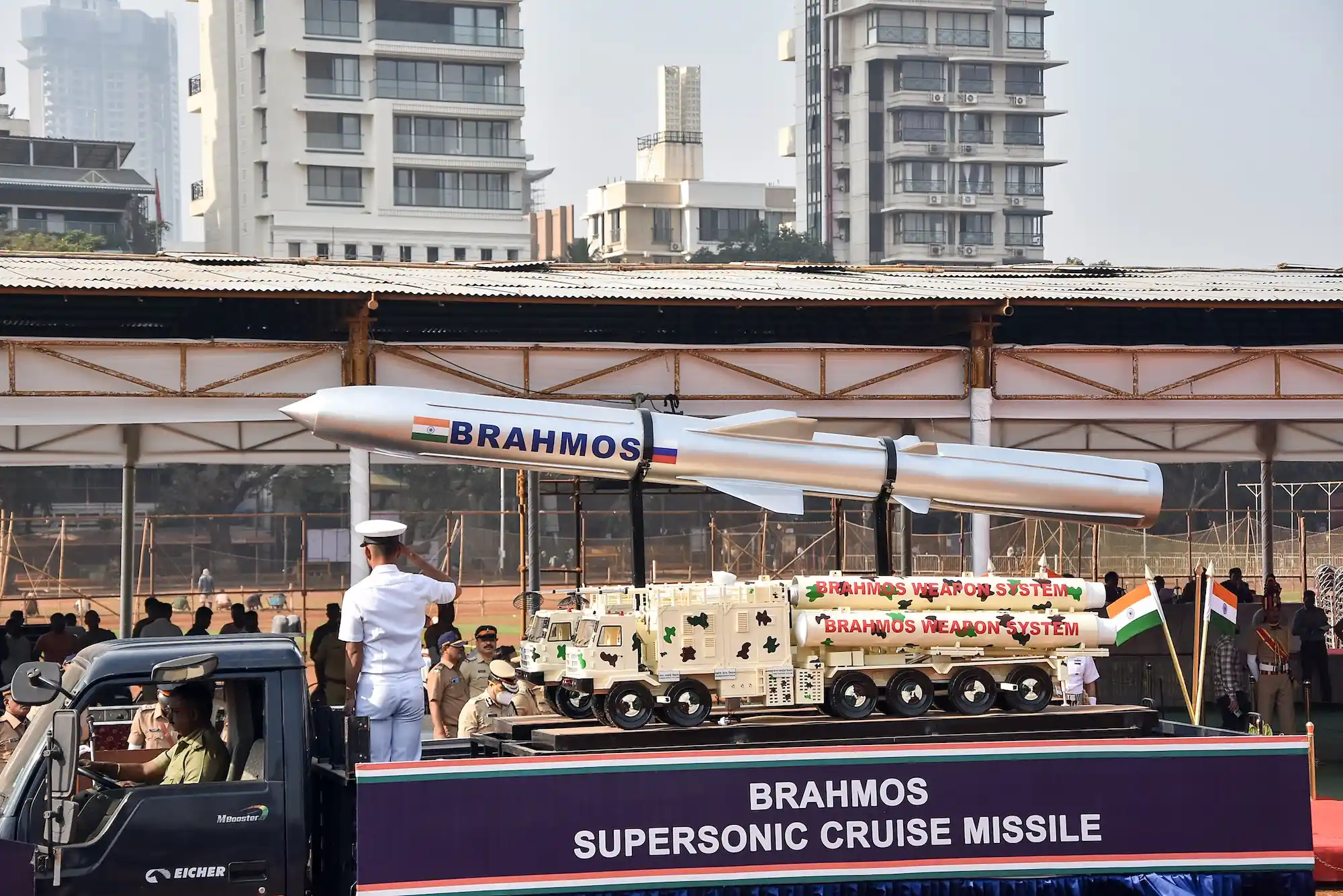
Southeast Asia is emerging as a key defence market for India, with its BrahMos missile in high demand. This supersonic cruise missile, jointly produced with Russia with a range of 180 miles, has triggered curiosity because of the missile’s speed, precision strike capability, and versatility, making it a formidable weapon for land, sea, and air as well as submarine-based attacks. Some 15 countries in Asia and South America, spanning from Thailand and Singapore to Brazil, Argentina, and Venezuela, all have shown interest in the missile. Among the Southeast Asian countries, the Philippines received the first batch of BrahMos missiles in 2024, becoming India’s first customer of the missile. India delivered the second batch of the missile to Manila this April and is preparing the third and final consignment of the missile delivery at the time of writing this article.
Meanwhile, Vietnam and Indonesia are also in the queue. This author faced questions regarding the prospect of India’s plan to sell BrahMos missiles to Vietnam from curious young scholars while visiting Hanoi back in 2015. Finally, India is nearing the finalization of a $700 million deal on the missile supply to Vietnam.
Indonesia is also on a mission to modernize its navy and is interested in the BrahMos missile. The country’s Navy Chief Admiral Muhammad Ali had raised the matter with his Indian counterpart Admiral Dinesh Kumar Tripathi in December 2024. Admiral Ali also led his team visiting BrahMos Aerospace headquarters in India this January and was briefed of the capabilities of the cruise missile. Anti-ship missiles have always been in Indonesia’s strategic vision to secure its maritime territory, and the BrahMos missile with a sophisticated guidance system serves the purpose well.
The defence trade is not a mere economic transaction meant to boost India’s international defence market. It bears a clear strategic connotation as well to contain China. Southeast Asia is the backyard of the Asian giant, and countries like Vietnam and the Philippines are entangled in territorial disputes with China in the South China Sea. Moreover, Vietnam, like India, is a victim of Chinese invasion, while the Philippines accuses China of regularly intruding in its maritime economic zone. Therefore, China has turned into a strategic challenge for both India and these Southeast Asian countries. Wary of Chinese misadventure, they want to boost their maritime security and consider India’s BrahMos missile as a major help. Thus, in a way, with BrahMos, India hits two birds with one stone- boosts both its ‘contain China’ as well as its defence export mission.
Not only for strategic reasons, the eastern waters are an important economic corridor for India’s trade relations with East Asia and the Pacific. More than 50 per cent of India’s trade takes place through the South China Sea, according to the government estimate. Meanwhile, the Chennai-Vladivostok eastern maritime corridor (connecting Vladivostok in eastern Russia with Chennai port) has already become operational. Thus, the South China Sea maritime zone falling into the Chinese hands exclusively is not desirable for India. Therefore, strengthening the naval power of the South China Sea littorals like the Philippines, Vietnam, and Indonesia is an important strategic decision.
However, the task is challenging since the USA, Russia, and China are in the race. Both the USA and Russia are known for supplying sophisticated weapons with seven decades of experience in the field. Vietnam has traditionally been the top buyer of Russian arms, while Manila has purchased arms from the USA. Although Russia’s market share in the region is dwindling lately, the USA remains dominant to this day, providing a broad range of military equipment. China’s share in the Southeast Asian defence market has also increased in the past two decades, but struggles against odds like reports of the deaths of several Indonesian personnel operating a Chinese-made air defence system in 2017, along with complaints about China-made vessels for the Royal Malaysian Navy. If India can upgrade the quality of its defence equipment and make them more attractive and reliable, it can capture a significant share of the defence market of Southeast Asia.
Visionary Singaporean leader and an India-admirer, the late Lee Kuan Yew, believed that Southeast Asia needs India to cope with China, and back in the 1960s, he wanted a military partnership with India amidst the China threat. Lee sought India’s protection following Britain’s planned force withdrawal from Southeast Asia in the late 1960s, but was left disappointed. However, time has vastly changed except for the China factor. Today, Southeast Asia is again offering India an opportunity to strengthen its defence partnership in a new form to cope with the common strategic challenge.