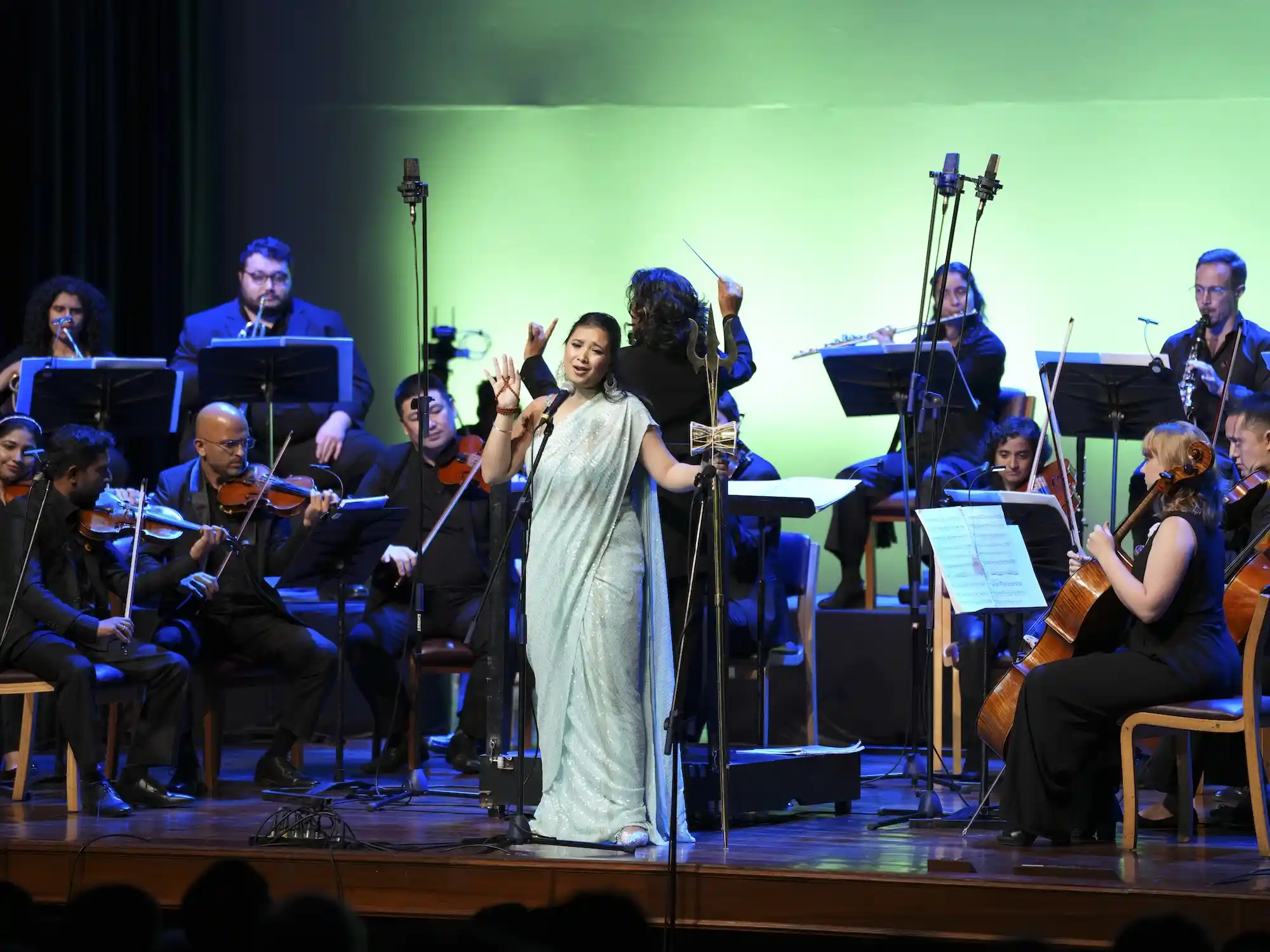
When the United Nations was created in 1945, it was as though the nations of the world agreed to sit in the same hall and play from a single score. The great symphony of humanity — long interrupted by the noise of a World War — would begin anew, promising balance and coherence, guided by a charter that spoke of peace, dignity, and shared destiny.
Eighty years later, the orchestra falters. The Security Council is locked in paralysis, multilateralism feels threadbare, and trust between nations is in retreat. Instead of tuning to one another, countries often play louder and louder, each demanding to be heard above the rest. The question facing us is stark: can the orchestra rediscover its score, or are we condemned to cacophony?
Difference arranged into Coherence
An orchestra is more than a group of musicians. It is a model for society, and perhaps for the world. Every instrument is distinct and indispensable: a violin does not drown the flute, nor does a trumpet mock the oboe. Each role is vital, even if only for a fleeting moment — a triangle’s strike, a gentle harp run.
The key is not uniformity but balance. Difference is essential. Without the percussion’s grounding, the strings would drift. Without the cello’s depth, the trumpet would be shrill. Harmony is not sameness; it is difference arranged into coherence.
Why is there no chaos? Because there is a score: the shared vision. And a conductor: not a dictator, but a unifier. The conductor makes no sound herself, but guides, balances, and interprets. In politics, the score is international law and collective aspiration; leaders are not soloists but stewards.
The metaphor is not mere poetry. It is a reminder that greatness is found not in overwhelming noise, but in listening — in playing one’s part with care, in time, in relationship.
In a healthy world order, the score is the UN Charter, human rights, and international law. Leaders should be conductors: their job is to listen, interpret, and guide. Not to silence, but to shape. We, the nations and peoples, are the musicians. Greatness lies not in dominance but in harmony, not in volume but in the art of listening.
Fellini’s Warning and Dylan’s Imagery
Federico Fellini’s 1978 film Orchestra Rehearsal captures what happens when the score is abandoned. Musicians squabble, undermine the conductor, and claim special privilege. The rehearsal collapses into anarchy, a parable of multilateralism undone by selfishness.
Bob Dylan caught a similar mood of looming collapse in his 1962 song A Hard Rain’s A-Gonna Fall (His imagery of poisoned waters, broken tongues, and forgotten songs is the lyrical twin to Fellini’s dystopia). The “hard rain” is not just meteorological; it is moral and political, the storm that comes when humanity refuses to listen to itself. Fellini and Dylan, though artists of different mediums, converge on the same warning: the danger of noise replacing music, discord overwhelming harmony.
South Asia’s Orchestra in Revolt
Nowhere is this clearer than in South Asia. The South Asian Association for Regional Cooperation (SAARC), launched in 1985, was meant to be our regional orchestra. Yet two lead players — India and Pakistan — have led the revolt. Summits lie suspended, dialogue frozen, cooperation blocked. Smaller members — Nepal, Bhutan, Sri Lanka, Bangladesh, Maldives, Afghanistan — find their voices silenced.
The result is stark: South Asia is one of the least integrated regions in the world, with intra-regional trade at the barest minimum. Where there might have been a symphony, there is mistrust and silence.
And yet, the traditional cultures of our region were not wired for conflict and indeed serve to generate a paradoxical resilience: despite the fractious nature of relations between South Asian countries today, traditionally, we were meant to be an integer. Our traditions are syncretic, sharing common roots, enriched by debate and inquiry. The South Asian commons enshrined that resilience and that paradox, that difference need not be discord, that we adapt, absorb and assimilate. That is the paradoxical resilience embedded in South Asia.
In my 2020 dialogue with the musician Ali Sethi, published in The Wire, he spoke of this paradox: “What I found through traditional music is this wonderful paradox: you find through these ‘traditional’ things genuinely radical, freeing, transformative, cosmopolitan, experimental worldviews.”
Tradition is not ossification. It can resist fracture, providing continuity and resilience. As Sethi recalled, “We grew up listening to qawwali and ghazal, to folk music to bhajan singers — it was all part of one musical landscape.”
And as I observed then: “You sit at a desk in an orchestra which you’re sharing with somebody else. He or she might be a stranger, but you bring your passion for music and inculcate with that passion, a sense of discipline, the art of listening.”
Indeed, the traditional cultures of our region were not wired for conflict and do carry a paradoxical resilience.
Harmony as Counterpoint
Counterpoint in music refers to the relationship of two or more simultaneous melodic lines or voices that are harmonically interdependent yet rhythmically and melodically independent. More generally, it can mean a contrasting or opposing element that complements or balances another. Melodic independence but harmonic coherence. Which is really what regional cooperation entails. Each constituent retains its distinct identity but yet coheres with the others, with the resultant sum being greater than the parts.
The South Asian Symphony Orchestra (SASO) was created to embody this principle. SASO gathers musicians from across South Asia, and also from Singapore, Central Asia, and the diaspora — more than 14 nations represented in some concerts.
At our inaugural concert in Mumbai in 2019, Afghan and Kashmiri musicians joined violins and clarinets, bringing rubab and santoor into conversation with strings and winds. It was a living metaphor: memory and hope, tradition and modernity, South and Central Asia, all in dialogue, that paradoxical resilience at work.
Ali Sethi’s song Chandni Raat conveys a similar message: of shared human experience, of loneliness and community, of people coming together in harmony, overcoming loneliness and hurt through their shared humanity. Sethi once described how the song became a refuge: “people immediately treated it as a safe space, as a place to congregate, to gather, to find shelter and to do dialogue.” SASO is that space — an orchestra of reconciliation rehearsing harmony in a fractured region.
Minilateralism: Chamber Music for a Fractured Symphony
With SAARC silent, new ensembles are emerging. These forms of minilateralism are like chamber works: smaller, purpose-driven coalitions that sustain music when the symphony cannot play and act as building blocks for multilateralism.
Examples include:
• BIMSTEC, linking South Asia to Southeast Asia.
• The Quad (India, Japan, US, Australia) in the Indo-Pacific.
• The IBSA Dialogue Forum (India, Brazil, South Africa).
• BRICS, shaping alternative narratives of global leadership.
These are not substitutes for the UN. They are rehearsals — small ensembles keeping the music alive, building trust, testing harmony. If nurtured, they feed back into the universal score. Like chamber music, they cannot replace the full symphony but can sustain trust, explore innovation, and hold space until the larger orchestra finds its voice again.
Trump and Götterdämmerung
Leadership shapes whether the orchestra coheres or collapses. President Donald Trump’s disdain for NATO, withdrawal from the Paris Climate Accord, and embrace of transactional bilateralism evoke Wagner’s Götterdämmerung — the “Twilight of the Gods.”
In Wagner’s cycle, the old order collapses in flames; the gods themselves fall. Trump’s “America First” is like the brass section blasting at full volume, disregarding the rest. In such conditions, why should others keep time? This is Fellini’s orchestra careening toward collapse.
We are thus pushing the world order toward orchestral dystopia — revolt and cacophony. And yet, as orchestral music shows, dissonance can resolve if the players recommit to the score.
The Ashoka Symphony: Renewal After Conquest
Against this dark metaphor of collapse, there is a prospect we are yet to explore: the Ashoka Symphony — yet to be conceived and written.
After the devastation of Kalinga, Emperor Ashoka renounced conquest, embracing compassion and pluralism. His edicts spoke of dialogue, restraint, and tolerance.
If Götterdämmerung is the twilight of the gods — collapse, flames, the end of order — then the Ashoka Symphony is its opposite: renewal, compassion after violence, harmony after dissonance. It reminds us that even from destruction, a new ethic of peace can emerge.
This is where soft power enters — not as an add-on, but as the music that holds the orchestra together. Joseph Nye’s classic definition, the ability to attract and co-opt rather than coerce, remains relevant. But today it must be rethought.
Soft power cannot be projection alone. It must be participation. Attraction now flows through culture, connectivity, and credibility. If values at home do not align with words abroad, the music rings false.
This is why cultural diplomacy matters: orchestras, residencies, exchanges. They are not ornamental but instruments of geopolitics. A rubab with a violin, a Kashmiri santoor with a clarinet, is a rehearsal for the political symphony we seek.
In a Project Syndicate piece, I argued that India must confront the turmoil in its neighbourhood with imagination and empathy. The orchestra metaphor shows why, without neighbours in tune, India cannot carry the melody alone.
Vishwaguru as Conductor
India is uniquely positioned to be both a musician and a conductor. With its civilisational depth, democratic experiment, and diasporic reach, it can play a bridging role across divides.
Regionally, cultural diplomacy — orchestras, exchanges, artist residencies, simpler visas — can nurture trust. Globally, India has shown through its G20 presidency that it can convene diverse voices.
India often speaks of its role as Vishwaguru — teacher to the world. But in the global orchestra, the Vishwaguru cannot be a soloist. It must be a conductor. The true teacher listens as much as it guides, harmonises rather than commands.
To be Vishwaguru is to ensure that the smallest instruments are heard, and that the tempo serves all, that no section overwhelms the rest. It is leadership through empathy, balance, and imagination.
The metaphors have a score. Fellini shows revolt. Dylan warns of the hard rain. Trump evokes Götterdämmerung — the twilight of the gods, the collapse of order. Ashoka offers its opposite: compassion, pluralism, renewal. Ali Sethi reminds us that tradition itself can be cosmopolitan, transformative.
India’s task is clear: conduct with humility, elevate neighbours’ voices, embody the Ashoka Symphony, and become Vishwaguru through philosophical guidance and through the art of listening.
An orchestra only exists when all contribute — in time, in tune, in relationship. That is the unfinished symphony of our world. And it is ours to conduct.