India’s emergence as the world’s third-largest car market has received a decisive boost with Suzuki Motor Corporation’s announcement of a massive $8 billion (₹70,000 crore) investment over the next five to six years. This commitment, the largest of its kind by the Japanese automotive giant, signals both confidence in India’s long-term growth story and a bold wager on the nation’s pivotal role in global automotive manufacturing and electrification.
India surged past Japan in 2024 to become the world’s third-largest car market, trailing only China and the US. Passenger car sales reached 4.3 million units last year, with SUVs accounting for nearly two-thirds of that figure, underscoring the nation’s evolving automobile preferences. Two-wheelers—a backbone of Indian mobility—crossed 19.5 million units, while commercial vehicle sales neared the one million mark.
The automobile sector now constitutes nearly half of India’s manufacturing GDP and about 7% of the entire economy, making it a central driver of employment and industrial expansion. Government estimates put the industry’s annual value at ₹22 lakh crore, up nearly threefold in the last decade.
Suzuki’s $8 Billion Bet: Shaping the Future
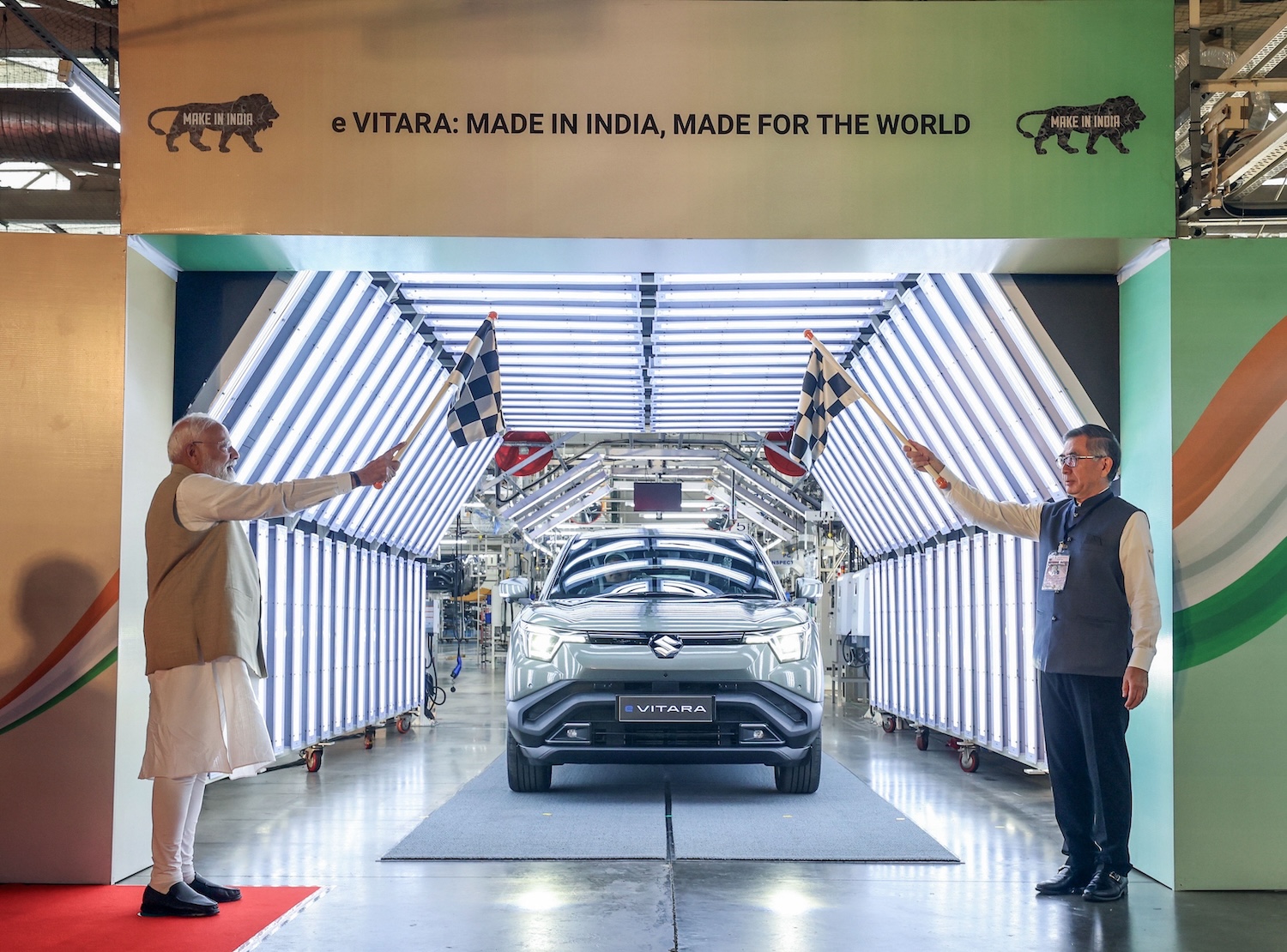
Suzuki’s investment, led by CEO Toshihiro Suzuki, aims to deepen its manufacturing and R&D footprint through Maruti Suzuki, India’s largest carmaker. The new commitment comes as Suzuki rolls out its first made-in-India electric vehicle—the e-Vitara SUV—from its upgraded Gujarat plant, now set to become one of the world’s largest automotive manufacturing hubs with a projected annual capacity of one million units.
Crucially, this facility will serve as Suzuki’s global production base for electric vehicles (EVs), exporting to over 100 countries, including advanced markets in Japan and Europe—an unprecedented move for a Japanese automaker in India.
Electrification and Innovation
While EVs remain a small slice of India’s passenger vehicle market—penetration is still in the single digits—government policies are rapidly changing the landscape.
| Scheme / Initiative | Launch Year | Budget Allocation | Key Targets / Achievements (as of mid-2025) |
|---|---|---|---|
| FAME-I (Faster Adoption and Manufacturing of Hybrid and Electric Vehicles – Phase I) | 2015 | ₹895 crore | Supported 2.55 lakh EVs; approved 520 charging stations |
| FAME-II | 2019 | ₹11,500 crore | Supported 16.29 lakh EVs; sanctioned 9,332 charging stations (8,885 installed) |
| PLI – Auto & Components | 2021 | ₹25,938 crore | Attracted ₹29,576 crore investment; 44,987 jobs created |
| PLI – ACC Battery Storage | 2021 | ₹18,100 crore | 40 GWh capacity awarded; target 60% domestic value addition within 5 years |
| PM E-Drive | 2024 | ₹10,900 crore | Subsidies for 24.79 lakh e-2Ws, 3.15 lakh e-3Ws, 5,643 e-trucks, 14,028 e-buses |
| PM e-Bus Sewa | 2023 | ₹20,000 crore | 7,293 e-buses approved in 18 States/UTs; ₹1,062.74 crore for depot & power infra |
| SPMEPCI (Electric Passenger Car Manufacturing Scheme) | 2024 | — | Reduced import duties for high-value EVs tied to localisation & ₹4,150 crore+ investment |
Schemes like FAME-II (Faster Adoption and Manufacturing of Hybrid and Electric Vehicles), with a budget of ₹11,500 crore, have already supported over 16 lakh EVs as of June 2025, including e-buses, e-two-wheelers, and e-three-wheelers. A complementary ₹912.5 crore has been sanctioned for installing 9,332 public charging stations, with nearly 8,900 already operational.
These efforts are backed by the Production Linked Incentive (PLI) schemes—₹25,938 crore for advanced automotive technologies and ₹18,100 crore for Advanced Chemistry Cell battery storage—designed to localise EV components and reduce dependency on imports. As of early 2025, the ACC scheme had allocated capacity for 40 GWh of battery production, targeting up to 60% domestic value addition within five years.
The push extends beyond personal vehicles. The PM e-Bus Sewa Scheme, with a ₹20,000 crore outlay, aims to deploy 10,000 electric buses via a Public-Private Partnership model, 7,293 of which have already been approved across 18 states and UTs. Meanwhile, the PM E-Drive initiative is India’s first direct incentive program for electric trucks, also covering e-two-wheelers, e-three-wheelers, and ambulances, with subsidies exceeding ₹7,500 crore to date.
These targeted policies are steadily narrowing the technology and cost gap between India and global leaders like China.
Market Potential: Youth, Urbanisation, and Rising Incomes
With just 44 vehicles per 1,000 adults—compared to over 500 in Japan and more than 250 in China—India’s car market remains vastly under-penetrated. Rapid urbanisation, a growing young population, and projected GDP growth of 6% annually are likely to push per capita incomes higher over the next decade, steadily increasing automobile ownership.
In the EV segment, momentum is already visible: electric two-wheeler sales in FY 2024–25 surged to 11.49 lakh units, up 21% year-on-year. The government has set an ambitious target of 30% EV penetration by 2030, aligning with the global EV30@30 initiative, and aims to cut projected carbon emissions by one billion tonnes by the same year.
| Indicator | Current Status (2025) | Target / Vision |
|---|---|---|
| EV Registrations | 56.75 lakh EVs out of 389.77 million total vehicles | — |
| EV Penetration Goal | ~3–4% overall | 30% by 2030 (EV30@30) |
| Carbon Emission Reduction | — | Cut 1 billion tonnes CO₂ by 2030 |
| Carbon Intensity | — | Below 45% by 2030; net-zero by 2070 |
| E-2W Sales (FY 24–25) | 11.49 lakh units (+21% YoY) | Continued growth with subsidies & infra |
| Charging Infrastructure | 9,332 sanctioned PCS (8,885 operational) | Nationwide network covering highways & urban hubs |
| Top IEMI Performers | Delhi, Maharashtra, Chandigarh | All States/UTs to reach “Performer” or “Frontrunner” status |
Global Context and Strategic Implications
Suzuki’s decision to double down on India comes as global EV sales slow and competitive pressures rise in established markets, particularly China. For multinational automakers, India’s combination of affordability, scale, and rising technological sophistication—ranging from 5G-enabled smart vehicles to indigenous battery manufacturing—offers not just growth potential but an opportunity for leadership in the global value chain.
Indian policymakers are fully aware of this window. Prime Minister Narendra Modi’s recent inauguration of the e-Vitara at Suzuki’s Hansalpur plant was as much a symbolic milestone as it was a strategic statement. Alongside vehicle production, the plant is now manufacturing hybrid battery electrodes domestically, ensuring over 80% localisation in battery value—a critical step toward Aatmanirbhar Bharat.
The India Electric Mobility Index: Tracking the Transition
To ensure progress is measurable and transparent, NITI Aayog launched the India Electric Mobility Index (IEMI) in August 2025. This pioneering tool ranks states and UTs based on EV adoption, charging infrastructure readiness, and R&D capabilities. Delhi, Maharashtra, and Chandigarh emerged as top “Frontrunners,” offering templates for other regions to emulate.
Such benchmarking not only recognises high performers but also guides policy support for states lagging behind, ensuring that India’s green mobility transition is geographically inclusive.
Infrastructure and Ecosystem Development
India’s green mobility drive is also addressing the “last-mile” challenge of charging access. Beyond oil marketing companies installing thousands of chargers at fuel stations, targeted funding is upgrading 980 existing charging stations and establishing new hubs along highways and in urban areas.
The ecosystem is also expanding into manufacturing depth: under the SPMEPCI scheme (Scheme for Promotion of Manufacturing of Electric Passenger Cars in India), global automakers are being offered reduced import duties for high-value EVs if they commit to significant domestic investments and localisation targets.
These measures, combined with private-sector innovations in battery swapping, smart charging, and connected mobility, are setting the stage for an EV-ready India.
Looking Ahead: From Aspirations to Achievements
While the government’s ambition to rival China and the US in automotive output within five years is bold, the trajectory is undeniably upward. Estimates suggest India could become a five-million-car annual market by 2030, with EVs forming a significant share of that growth.
The dual focus—expanding the overall automotive market while rapidly greening it—positions India uniquely in the global landscape. Where other nations must retrofit existing high-penetration, fossil-fuel-dominated fleets, India’s low base offers a chance to leapfrog directly into clean mobility at scale.
Green mobility in India is no longer a niche aspiration—it is a mainstream industrial and societal shift. Suzuki’s massive investment, coupled with sweeping policy measures and infrastructure rollouts, is transforming India into both a manufacturing powerhouse and a testing ground for the future of mobility.
From the quiet hum of electric buses in crowded cities to the roar of assembly lines producing next-generation EVs for the world, India’s road to electric dominance is being paved at remarkable speed. The next decade will not just determine whether India meets its EV adoption targets—it will decide whether the country becomes the global epicentre of the electric mobility revolution.