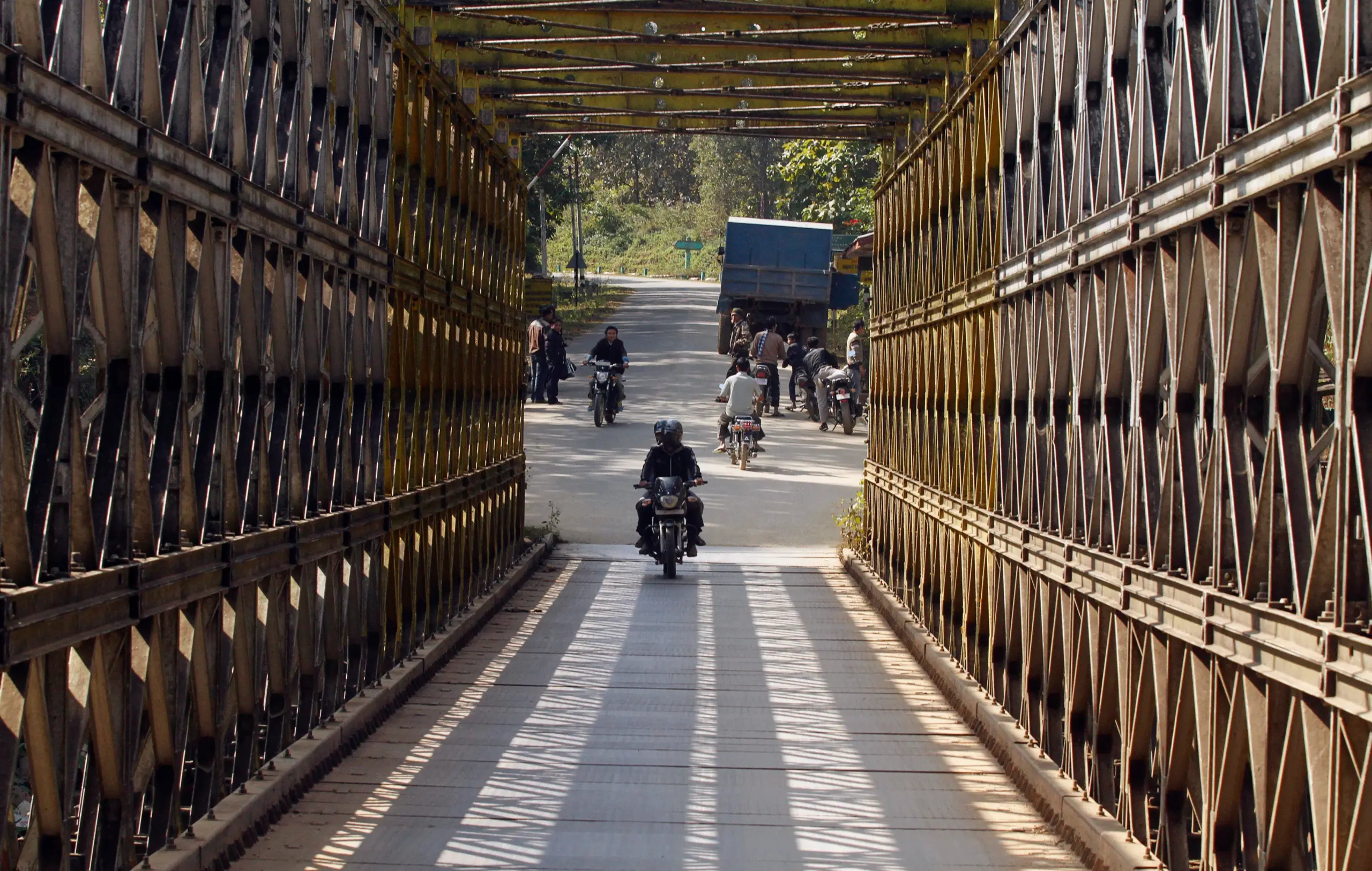
Over the past five years, Manipur has witnessed significant advancements in infrastructure development, particularly in railway connectivity, road networks. A major portion of the project, the 55-kilometre stretch from Jiribam to Khongsang in Tamenglong district, has already been completed, and freight train services have become operational. Work is steadily progressing for the construction of Imphal Railway Station.
A remarkable engineering feat associated with this railway project is the construction of a massive bridge in Noney district. Rising to a height of 141 metres, the bridge will surpass the height of the Qutub Minar and is expected to become the tallest railway bridge in the world once completed. The installation of girders for this structure has already been completed.
Parallel to railway expansion, road and national highway development has seen substantial progress. Over the last five years, a total of 51 road and National Highway project packages has been undertaken, with an estimated investment of ₹12,000 crore. The total National Highway network in Manipur spans approximately 1,774 kilometres, of which about 747 kilometres have been upgraded and blacktopped, while work is ongoing on an additional 332 kilometres. The development work is largely driven by the Government of India through agencies like NHIDCL and MoRTH.
Several key highways have undergone major improvements. The Imphal–Moreh road along National Highway 102 has been upgraded to a four-lane highway with paved shoulders, significantly enhancing connectivity with Myanmar and boosting trade prospects. Similarly, large sections of National Highway 37 connecting Imphal to Jiribam have been blacktopped, strengthening the link between Manipur and Assam. Upgradation work on National Highway 02, connecting Imphal to Kohima, is also in progress, with the road being widened to a two-lane highway with paved shoulders.
Despite challenging terrain in the hill districts road infrastructure development have gained pace. Projects along National Highway 202 in Ukhrul district, the Ukhrul–Tadubi road, and the Tamenglong–Mahur road along National Highway 137 are progressing steadily. In southern Manipur, work on National Highway 102B connecting Churachandpur to Tuivai is underway, while the Maram–Peren Road project that is connecting Senapati and Nagaland is nearing completion, the route is regarded as an alternative lifeline for bringing in essential commodities into the State.
In addition to highways, urban infrastructure has seen a major shift with the introduction of rigid pavement roads, particularly in Imphal and other district headquarters. Under the Manipur Urban Road, Drainage and Asset Management Improvement Project, a large-scale initiative supported by the Asian Infrastructure Investment Bank, approximately 547 kilometres of roads are being developed at an estimated cost of ₹3,647 crore. The project is replacing traditional bitumen roads with cement concrete roads.
Despite these advancements, challenges remain. Issues such as inadequate supervision during initial project phases, temporary road narrowing during construction, and the need for skilled labour in handling new construction technologies have affected the pace and efficiency of some projects. Additionally, difficult terrain and climatic conditions continue to pose obstacles, particularly in hill districts. However, more than ten percent of the project has been completed so far and the project is on hold. The duration of the project is three years and five years of maintenance. The Public Works Department, Manipur is implementing the project.
Other Key Infrastructural Development
Some key infrastructure developments that have taken place include administrative buildings, urban services, digital infrastructure, healthcare, and social amenities, all of which are essential for improving governance and quality of life. The construction of the new Civil Secretariat at Mantripukhri has significantly improved administrative efficiency by centralising key government offices. Similarly, the establishment of a modern Police Headquarters at Mantripukhri has strengthened law enforcement infrastructure and enhanced coordination among security agencies.
In the field of digital infrastructure, initiatives such as the Manipur Infotech Enabled Development (MIND) Project have been introduced to strengthen IT infrastructure, promoting digital services, and supporting the growth of startups and the IT industry. The development of an Information Technology Special Economic Zone (IT SEZ) aims to attract investment, create employment opportunities, and integrate the state into the broader digital economy. The project is being supported by World Bank and is a Rs 500 crore worth initiative.
Healthcare infrastructure has also been a priority area. Upgradation of district hospitals, construction of new healthcare centres, and improvements in medical facilities have enhanced access to healthcare services, particularly in the periphery. In addition, social infrastructure has expanded. New hostels and residential facilities have improved safety and accommodation for women, while investments in sports infrastructure, such as indoor stadiums and training centres, are encouraging youth participation and talent development.