
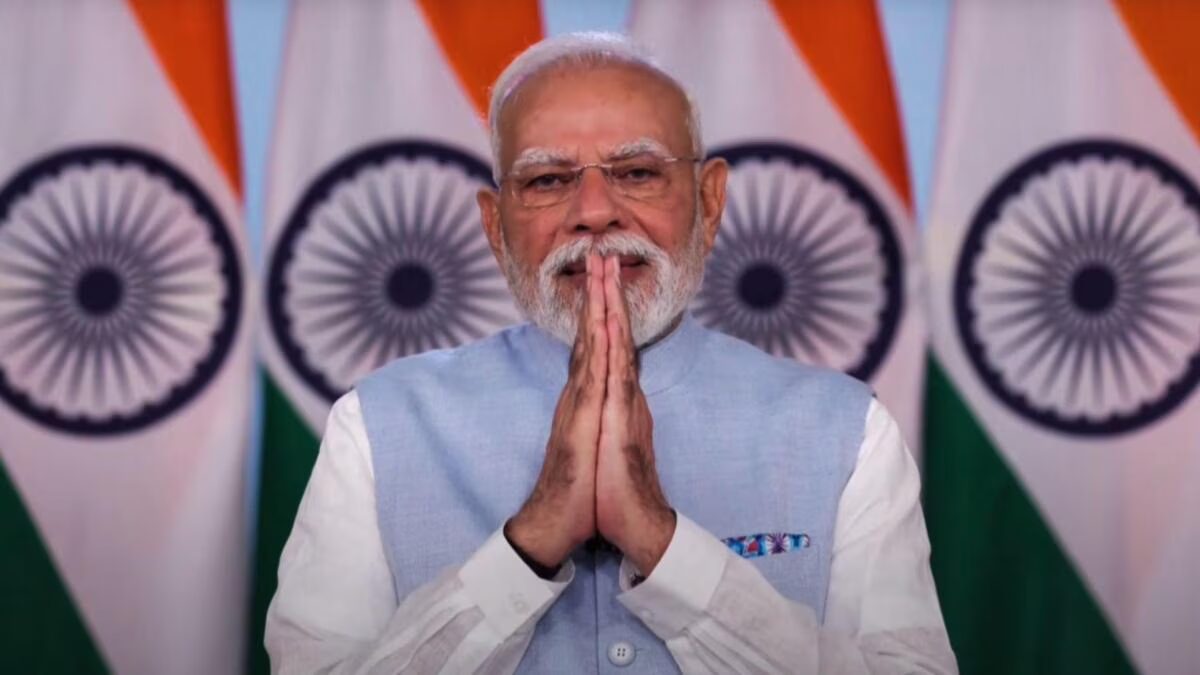
Prime Minister Narendra Modi addressed the nation on Sunday evening, on the eve of the rollout of the Goods and Services Tax (GST) 2.0 reforms, describing the initiative as a “GST Bachat Utsav” (GST Saving Festival) that would strengthen savings, boost investment, and accelerate India’s economic growth story.
Speaking just ahead of Navratri, the Prime Minister linked the reforms with India’s journey toward self-reliance. “From the first day of Navratri, the country will take a step towards Atmanirbhar Bharat. Tomorrow, the next generation GST reform will be implemented,” he said.
Relief for the Middle Class
PM Modi highlighted that the twin decisions to raise the income tax exemption limit and to introduce GST 2.0 reforms would collectively save Indian citizens approximately ₹2.5 lakh crore. Everyday essential items, he emphasized, will either remain tax-free or attract only a minimal 5% GST.
“This is like a double bonanza for the middle class. These reforms embody the spirit of ‘nagrik devo bhava’,” Modi remarked, underlining that the changes are designed to ease the financial burden on ordinary citizens while encouraging consumption.
Ending a Web of Taxes
The Prime Minister also recalled India’s tax landscape prior to the landmark GST reform in 2017, describing it as a maze of levies such as octroi, entry tax, excise, VAT, and service tax. “For decades, our traders and citizens were entangled in dozens of taxes. To send goods from one city to another, countless checkpoints had to be crossed,” he said.
Citing a striking example from a foreign newspaper in 2014, Modi noted how a company found it easier to send goods from Bengaluru to Europe and then ship them onward to Hyderabad, rather than directly transport them within India. “This was the situation at that time. The increased expenses of such inefficiency were ultimately borne by the poor,” he added.
Building on MSMEs and Swadeshi
Looking ahead, the Prime Minister called on micro, small, and medium enterprises (MSMEs) to take advantage of the simplified tax system. “When India was at the peak of prosperity, MSMEs were its foundation. We must reachieve that,” he said, urging businesses to focus on product quality and embrace swadeshi (locally made goods).
Encouraging citizens to support homegrown products, Modi appealed: “Every home and shop should represent swadeshi. When this happens, India will progress, and our prosperity will rise.”
A Step Toward Growth
Describing the GST 2.0 rollout as a “festival of savings,” the Prime Minister said the reforms would not only simplify taxation but also act as a catalyst for investment, employment, and economic expansion. “This will accelerate India’s growth story,” he affirmed.
With the reforms set to take effect from tomorrow, Modi expressed confidence that they would mark yet another milestone in India’s ongoing economic transformation.

