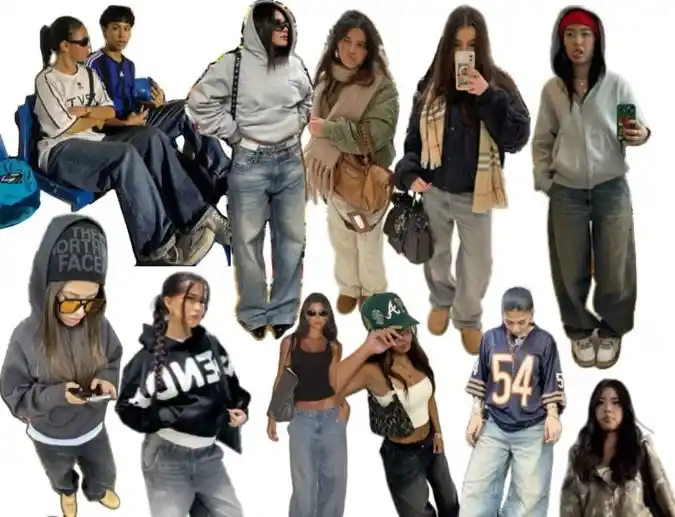
Some days, when I’m walking through a mall or scrolling on my phone, I get a strange, quiet déjà vu. Not of a place, of an outfit. The same straight-fit denim. The same ribbed tank in four colours. The same white sneakers, the same thin gold hoops, the same softly blown-out hair. Different people, different cities, almost identical wardrobes.
And somewhere between the fourth and fifth déjà vu, the question lands:
When did getting dressed start feeling like filling a form?
This isn’t a micro-trend.
It’s a cultural shift, accelerated by algorithms, softened by aspiration, and made oddly seamless by global retail.
The Global Moodboard Effect
There was a time when Indian fashion carried strong regional inflections.
Mumbai’s laid-back edge.
Delhi’s performative glamour.
Kolkata’s intellectual linens.
Shillong’s streetwear nerve.
Chennai’s crisp, sunlit cottons.
Today, these distinctions are blurring.
Search “outfit ideas” on Pinterest and the world collapses into one aesthetic: neutrals, ribbed basics, quiet luxury, soft minimalism, Scandi silhouettes.
Scroll through Instagram and creators across continents look interchangeable, just swapping Copenhagen’s cobblestones for Bandra Reclamation.
Retail follows this logic with unnerving efficiency:
What performs online gets produced.
What gets produced fills stores.
What fills stores becomes the new default.
We aren’t copying each other.
We’re all referencing the same moodboard.
AI Has Flattened the Fashion Imagination
Inside design teams, another force is reshaping taste: AI lookbooks.
AI doesn’t understand cultural nuance or regional character.
It doesn’t understand the beauty of “almost right”; an imperfect drape, an awkwardly charming sleeve, a local quirk.
It offers the same smooth-skinned model, the same linen-blend blazer, the same desaturated palette.
Perfect. Predictable. Palatable.
Scroll long enough and the world begins to look AI-generated, because, increasingly, it is. And humans, unintentionally, start dressing like the machine.
The Quiet Disappearance of Indian Visual Identity
Across India’s markets, something subtle but profound is shifting.
Sarojini Nagar now mirrors the front table at Zara.
A boutique in Indore sells the same corset tops from a Korean haul.
A college student in Ranchi dresses exactly like someone in London.
A boy in Kochi could easily blend into Brooklyn.
Some of this is ambition.
Some of it is access.
But a part of it feels like erasure.
Indian fashion was once shaped by its ecosystem:
Humidity determined silhouettes.
Festivals determined colours.
Mothers determined modesty.
Tailors determined individuality.
Now, the algorithm determines all of it.
Retail’s New Vocabulary is Algorithm-First
Inside buying meetings across the country, a new language dominates:
“Pinterestable.”
“Search-friendly.”
“Capturable.”
Translation:
A garment’s value lies in how neatly it fits a grid, not how gracefully it moves on a body.
Even Indian wear has succumbed to the script: pastels, minimal embroidery, softened silhouettes, universally photogenic tones.
It’s beautiful, but homogenous.
Elegant, but indistinguishable.
Aesthetic, but emotionally flat.
A world where everyone dresses “well,” but no one dresses differently.
The Real Question: What Happens to Individuality?
If fashion is expression, what happens when the expressions match?
Where does personal style live in a world governed by “trending now”?
How do designers push boundaries when sameness is the safest business decision?
What becomes of regional fashion languages when visibility, not culture, decides value?
It feels like we’re losing more than silhouettes.
We’re losing instinct.
Taste.
Courage.
The small acts of rebellion that built personal style in the first place.
But Maybe Sameness is a Symptom, Not a Problem
Here’s the quieter truth.
Maybe people are tired.
Maybe simplicity feels safe.
Maybe the global uniform is less about conformity and more about self-preservation.
Neutral palettes promise calm.
Clean lines promise control.
Repetition feels therapeutic in a world that rarely slows down.
Uniformity, in this sense, is not aesthetic obedience; it’s emotional coping.
But still:
What happens to creativity when comfort becomes the primary driver?
Where Fashion Goes Next
I don’t believe we’re heading toward a beige apocalypse.
Uniforms always fracture.
Trends always fatigue.
And individuality always returns, through the side door, if not the front.
I already see the first cracks:
A mangalgiri sari over a tank top.
A vintage jacket disrupting the “clean girl” palette.
A Gen Z boy pairing cargo pants with his father’s shirt.
Handwoven Indian textiles slipping into everyday wardrobes.
Runways flirting (again) with joyful maximalism.
People don’t abandon self-expression; they rediscover it.
The future isn’t about rejecting global style.
It’s about speaking it with our own accent.
Because fashion should feel like language, rooted, textured, personal, not a template downloaded at scale.
And perhaps the next chapter is simply this:
a return to dressing in our own mother tongue.