India–Canada relations over the past year have followed a pattern increasingly common in a fragmented global order. The political crisis came first. Institutional freeze followed. Quiet security repair began after that. Economic re-engagement is now emerging as the final stage.
Viewed through headlines, the relationship still appears to be recovering. Viewed chronologically, however, what is underway is more structural. The two countries are not simply restoring diplomatic normalcy. They are rebuilding a more insulated, transaction-driven partnership anchored in trade, investment flows, energy security, and institutional security cooperation.
2024 Crisis
The last visit by a Canadian Prime Minister Justin Trudeau to India during the G20 Summit in 2024 took place under visible political strain. Following public allegations by Canada implicating India in transnational criminal activity on Canadian soil, the already narrow political bandwidth became even more constricted.
The breakdown phase was accelerated by political and diplomatic management choices during the tenure of Prime Minister Justin Trudeau and Foreign Minister Mélanie Joly. The public framing of sensitive security concerns before investigations were completed, judicial processes were initiated, and before diplomatic coordination mechanisms were fully activated, produced immediate diplomatic consequences, accelerating the breakdown of bilateral relations. Reciprocal persona non grata declarations, involving senior diplomats, including the Indian High Commissioner to Canada, marked one of the lowest operational points in bilateral engagement in decades.
The more serious damage was institutional. Diplomatic expulsions create long bureaucratic memory inside foreign ministries, intelligence agencies, and law enforcement institutions. These memories outlast governments. The current repair phase is therefore not simply normalisation. It is an attempt to build structural guardrails.
Even during the stressed political relations, core economic engagement continued. Canadian pension capital maintained deep exposure to Indian infrastructure, renewable energy, and logistics. Canadian institutional investment in India has now crossed well above USD 70 billion and is widely assessed to be approaching USD 80 billion when broader exposures are included.
2025: The Quiet Reset
The structural reset began through preparatory diplomatic engagement. Foreign Office consultations between officials of India’s Ministry of External Affairs and Global Affairs Canada helped rebuild technical communication channels.
An important stabilising counterpoint came when Prime Minister Narendra Modi travelled to Kananaskis, Canada, for the G7 outreach engagement. Even during difficult bilateral conditions, leader-level engagement continued through multilateral platforms. In diplomatic practice, this matters. Once leadership dialogue collapses completely, recovery becomes far slower. The two Prime Ministers met on the sidelines of the G20 Summit in Johannesburg as well, giving a clear political signal for the bilateral relations to recover in economic, political, and security domains.
Political re-engagement followed in both directions.
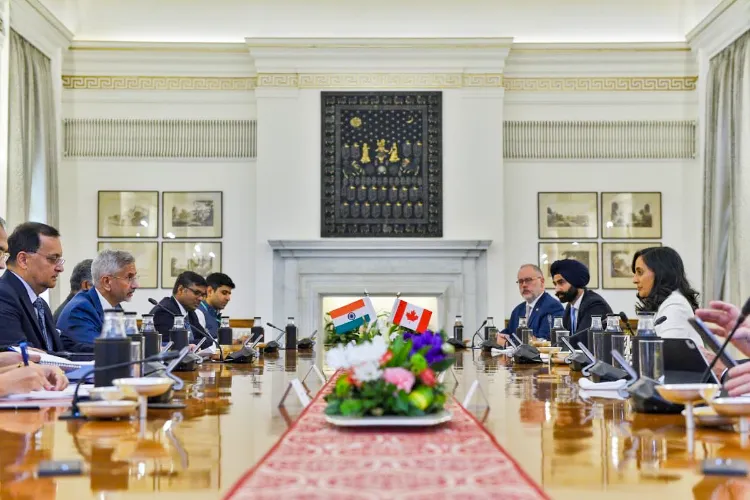
Canada’s Foreign Minister Anita Anand visited India, reopening high-level political and economic dialogue. The visit focused on rebuilding cooperation frameworks across trade, energy, climate cooperation, science and technology, agriculture, and mobility.
This phase was reinforced by the visit of the Canadian Minister of International Trade, Maninder Sidhu, to attend the 7th Ministerial Dialogue on Trade and Investment. The dialogue reaffirmed commitment to deeper commercial engagement and resilient supply chains, particularly in critical minerals and clean energy. It also emphasised mobility frameworks for skilled professionals and students as a pillar of innovation cooperation.
India’s engagement with Canada during this period was equally significant. India’s External Affairs Minister participated in G7 Foreign Ministers’ outreach engagements hosted by Canada, reinforcing India’s willingness to maintain strategic dialogue even during bilateral recalibration.
2026: Strengthening
By early 2026, engagement shifted from normalisation to sectoral alignment, especially in energy.
The visit of Canada’s Minister of Energy and Natural Resources, Tim Hodgson, was a part of Canada’s strong participation in India Energy Week, including federal and provincial representation and engagement linked to Alberta leadership, including Minister Rajan Sawhney. This signalled long-term supply intent.
The structural logic is clear. Canada holds the world’s third-largest proven oil reserves at over 165 billion barrels. India imports more than 85 percent of its crude consumption and will remain among the world’s largest importers through at least 2040.
India’s LNG demand is projected to rise from roughly 65 billion cubic meters annually today to potentially over 110 billion cubic meters by the early 2030s. Canada’s west coast LNG export capacity aligns naturally with Indo-Pacific demand growth.
Canada’s uranium production capacity aligns with India’s expanding nuclear program, which currently stands at around 7.5 GW and is expected to grow significantly.
Agricultural trade remains a stabilising pillar. Canadian pulse exports to India hover around USD 600 million, depending on crop cycles.
The visit of India’s National Security Advisor Ajit Doval to Canada in February 2026 marked a decisive institutional reset.
Both countries agreed to a shared workplan covering national security and law enforcement cooperation and agreed to establish liaison officers within each other’s systems.
Cooperation focused on illegal drug flows, particularly fentanyl precursor supply chains, and transnational organised crime networks. Canada’s opioid crisis has made this a national security priority.
Both sides also agreed to formalise cybersecurity cooperation and structured information sharing. With global cybercrime losses exceeding USD 8 trillion annually, cyber cooperation now forms a core pillar of security cooperation.
This security normalisation is critical for economic expansion. Long-term capital flows and energy contracts require predictable political risk environments.
The Carney Moment
Prime Minister Mark Carney’s expected visit to India is likely to mark a transition from stabilisation to structured expansion in the bilateral relationship, with a strong emphasis on trade architecture, investment flows and long-term energy integration. Movement toward finalising the Terms of Reference for a Comprehensive Economic Partnership Agreement could represent the most consequential next step in institutionalising economic engagement between the two countries.
Greater regulatory facilitation of Indian exports in pharmaceuticals, digital services, engineering goods, and refined petroleum products would significantly expand Indian market access in Canada. Reciprocally, India is expected to further open market space for Canadian exports in energy resources, potash, pulses, timber, and advanced agricultural technology. Canadian institutional capital already ranks among the largest sources of foreign institutional investment in Indian infrastructure and renewable energy. A structured trade framework has the potential to substantially scale bilateral trade volumes over the coming decade, possibly doubling current levels if tariff, regulatory, and mobility barriers are progressively reduced.
Beyond trade, the visit is likely to help define a clearer economic, security, and strategic template for the next phase of the partnership. Energy cooperation is expected to deepen through structured hydrocarbon supply engagement and expanded discussions on long-term uranium procurement to support India’s civil nuclear expansion and clean baseload energy requirements. Supply chain complementarities are likely to drive reciprocal market access conversations across agriculture, energy, advanced manufacturing inputs, and services trade. Industrial and technology collaboration is expected to expand across critical minerals processing, advanced materials, aerospace, digital technologies, and next-generation manufacturing ecosystems. Clean and green technology cooperation, including renewable energy integration, carbon management technologies, and emerging hydrogen value chains, is likely to emerge as a defining pillar of the relationship. Parallel expansion is expected across innovation ecosystems, including research collaboration, start-up partnership,s and advanced skills mobility.
Alongside economic priorities, the visit is also expected to reinforce cooperation on security challenges, including addressing cross-border terrorism, including Khalistani networks and anti-India elements operating from Canada, alongside their financing and transnational enablers. Enhanced coordination between law enforcement and security agencies is likely to focus on intelligence sharing, disruption of illicit financial flows, and joint action against organised criminal and terror-linked supply chains. At the multilateral level, both sides are also expected to reiterate support for reform of global governance institutions, including the United Nations system, to better reflect contemporary geopolitical and economic realities, strengthen counter-terror cooperation frameworks, and improve the effectiveness of global development and security responses.
Equally, the Indian diaspora in Canada is expected to remain central to the next phase of engagement, serving as a bridge across business networks, technology ecosystems, education systems, and long-term capital flows, while reinforcing the people-to-people trust that underpins sustained strategic and economic cooperation.
The Real Test
Success will not be measured in statements. It will be measured in outcomes. Do trade negotiations begin with timelines? Do energy agreements become long-term contracts? Do security dialogues become routine? Do diplomatic missions regain full operational trust?
India and Canada are not bound by geography or alliance structures. They are bound by economic complementarity and shared global governance interests. Historically, such relationships tend to endure.
If current trends hold, the next decade of India–Canada relations may be defined less by political turbulence and more by investment flows, energy integration and supply chain partnerships and deeper people-to-people linkages.
And in international relations, those are the relationships that last.