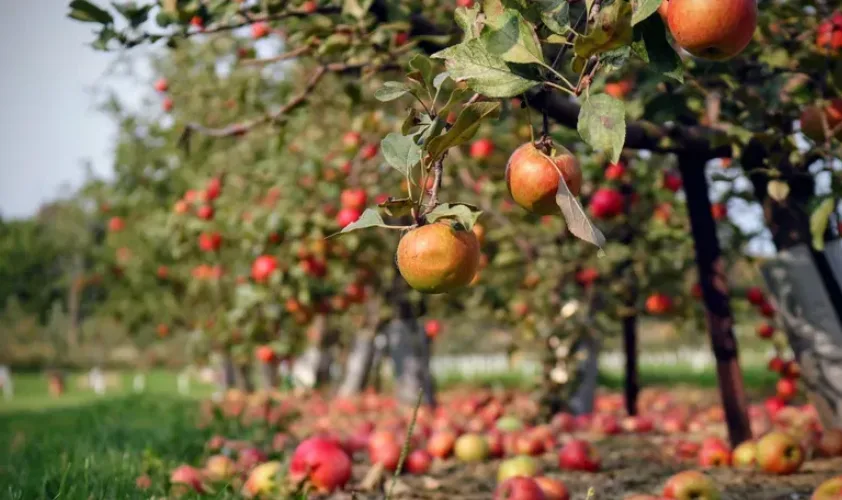
Already grappling with warming winters, failed snowfall, and missing rains, all signs of a big climate shift, the apple growers in Himachal Pradesh, a state producing rich, crisp, and royally delicious apples, are finding themselves pushed to the edge after changing free trade dynamics in the country.
Extending them a helping hand, the state’s Chief Minister Sukhwinder Singh Sukhu last week decided to take their battle to the doorsteps of the Union Government in New Delhi and urged for urgent intervention against the crippling influx of foreign apples in India.
Sukhu met with Union Finance Minister Nirmala Sitharaman and Union Minister for Commerce and Industry, strongly advocating the cause of over 2.5 lakh apple growers.
He asked the union ministers to include apples in the ‘Special Category’ to protect domestic growers from unfair international competition, especially in the wake of the Free Trade Agreement (FTA) with New Zealand, proposing a tariff cut to about 25 percent. This enables the exporters from New Zealand to market their seasonal products, including apples, to India.
The chief minister put forward a demand to impose a ban on all apple imports during the peak production period in Himachal, i.e., July to November, and a hike in the import duty of apples to 100 percent during off-season months to discourage foreign dumping. He requested that quantitative restrictions be imposed on apple imports.
The Chief Minister pointed out that imports have surged 2.5 times over the past ten years. The 25 percent duty exemption for New Zealand apples during the April-August window was crashing prices for local apples stored in CA/cold storage facilities, effectively destroying the off-season trade for Himachal’s growers.
This was, indeed, after a delegation of apple producers met the Chief Minister in Shimla, a day before he flew to Delhi, raising concerns over the reduction of import duty on apples imported from New Zealand, which had adversely affected the interests of local orchardists.
The apple industry in Himachal Pradesh, an economy of Rs 5,500 cr has been sustaining 2.5 lakh growers, contributing nearly 80 percent of the state’s total fruit production.
‘”This is not just about fruit; it is about the livelihood and sustenance of rural families, mostly marginal farmers, and the generation of 10 lakh man-days of employment. The foreign apples, reaching the Indian markets due to reduced import duty, result in a price crash and create an unhealthy competition,” the growers explained.
They demand exclusion of apples from certain free trade agreements and a ban or higher import duty to shield domestic produce from cheaper foreign apples that undercut prices. They also sought regulation reform, better support prices, and government intervention schemes to stabilise incomes. Protests and meetings with officials reflect these unresolved grievances and fear of a collapsing apple economy without urgent action.
“Free Trade Agreements (FTAs) are seen by Himachal Pradesh apple growers as a serious threat because they expose a fragile, climate-stressed domestic sector to unequal global competition,” Sukhu told the union ministers during his meetings.
Under FTAs, India reduces or eliminates import duties on apples from countries such as the US, Australia, New Zealand, Chile, and Iran. These countries produce apples on a much larger, mechanised scale, enjoy heavy government subsidies, advanced storage, grading, and cheaper logistics.
Said Sanjay Chauhan, a former Shimla mayor, “Unlike foreign producers, Himachal apple growers face climate volatility, small landholdings, limited cold-storage access, and weak market bargaining power. FTAs are bound to hit the apple growers hard, not only in Himachal Pradesh but also in Jammu and Kashmir and Uttarakhand,” also suggesting that apples should be treated as a “sensitive agricultural commodity” and protected through higher minimum import prices and safeguard duties.
On Monday, the farmers’ unions, affiliated with the left-wing organisations, held a protest in Shimla and submitted a memorandum to Chief Minister Sukhwinder Singh Sukhu seeking effective intervention of the state government to save the interests of apple producers and provide better marketing facilities.
Himachal Pradesh is currently passing through a severe dry spell, depriving the apple orchards of snow and winter rains for the third consecutive year.
The state’s Meteorological Department reports that January 2026 has witnessed only 3.1 mm of precipitation so far, a 93 per cent deficit compared to the normal 45.1 mm.
The state recorded its ninth driest November since 1901 and sixth driest December since 1901, with rainfall deficits of 95 and 99 percent, respectively. Kullu and Kinnaur districts have witnessed the highest dry spell this month, with a 100 percent rainfall deficit. Both districts have received 0 mm of precipitation against normal levels of 50 mm and 52 mm.
Snow is considered crucial for the apple crop and provides mandatory chilling hours for a better crop.
Chilling hours are critical for uniform bud break and fruit set; without sufficient cold, flowering becomes irregular and yields suffer. With winters growing warmer and snowfall increasingly erratic, many orchards, particularly at lower elevations, are failing to accumulate the chill they need.“Apple trees need a specific amount of winter chilling hours when temperatures stay at or below about 7°C (45°F)—to break dormancy, flower well, and produce a good crop. However, this year, the orchards are facing a lack of snowfall. If things don’t change in the next few days, we are going to see a worse crop failure,” says S P Bhardwaj, a veteran horticulture scientist at Shimla.