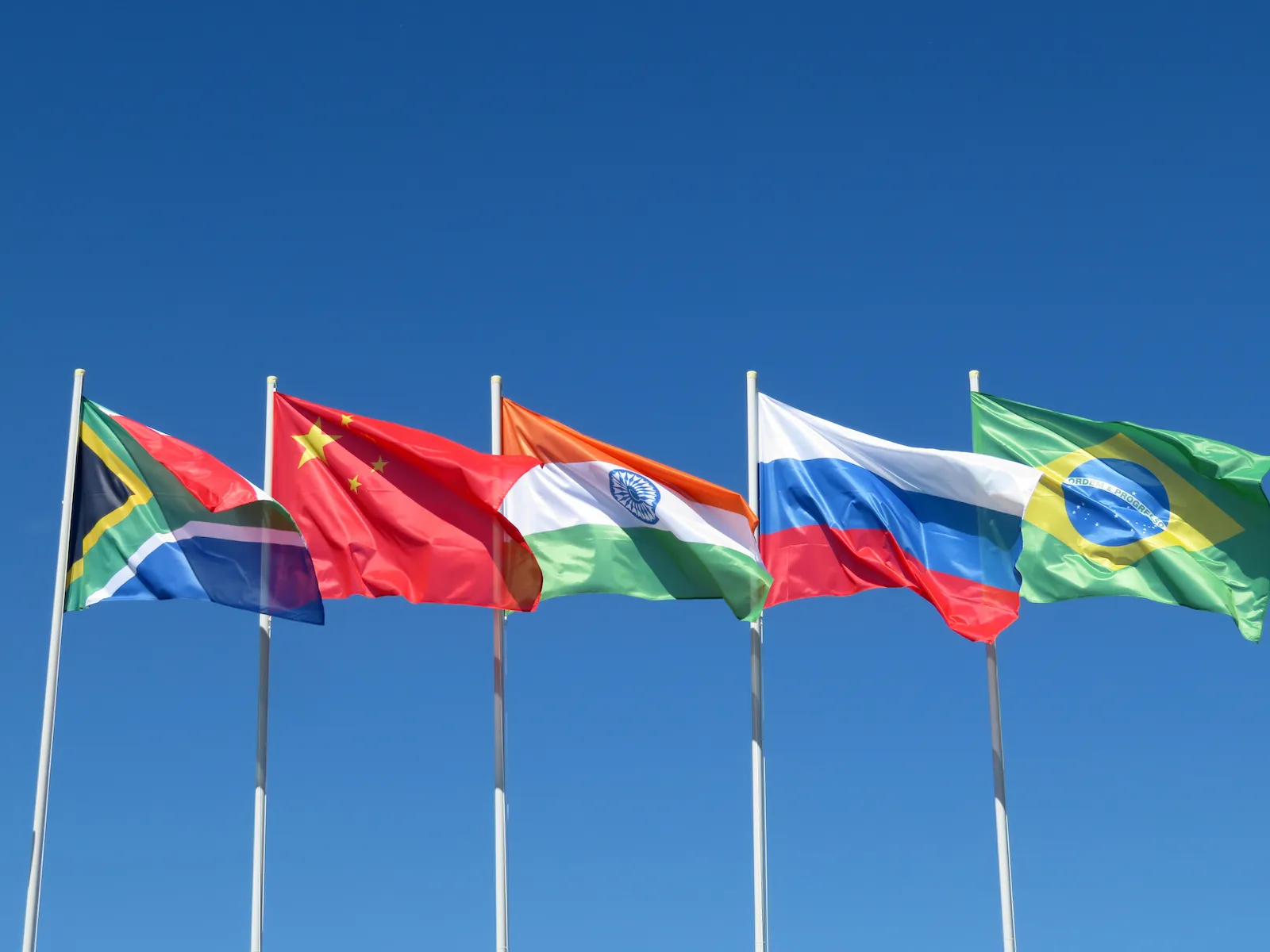
The 21st-century international relations are viewed in terms of the attrition of Western dominance and the simultaneous rise of the non-Western world. Eminent scholar Kishore Mahbubani, in his book The Asian 21st Century, highlights the return of Asian glory, driven by the huge economic and social advancement of Asian societies, especially India and China. And he cites India as one such country emerging as an independent pole, providing calm leadership in today’s turbulent geopolitical world. And the BRICS platform, comprising major non-Western powers such as Russia and China, along with India and South Africa, offers India the opportunity to play such a leadership role.
Amid competing global interests, trade tensions, and the US’ tariff onslaught, India is assuming the BRICS presidency this year. During its presidency, India gets the chance to promote the interests of the ‘Global South’ via BRICS, endorsing the demand of the developing world for their ‘rightful place’ in the global financial system and greater voice in world affairs. India has traditionally championed this desire of the neglected world. Therefore, it supported strengthening the Global South Cooperation, underlining inclusive and sustainable growth and cooperation as mentioned in the 2025 BRICS Rio de Janeiro Declaration. India has advocated for the 5 Cs‟ for the Global South: consultation, cooperation, communication, creativity, and capacity building, to promote collective progress.
Another area of focus of India’s BRICS presidency will be to promote multilateralism, committing to reforming and improving global governance by promoting a more just, equitable, effective, and accountable international and multilateral system. India underscores the importance of collaboration with diverse partners, showcasing initiatives such as the G20 Presidency, development partnerships, and alliances, including BRICS. Thus, Prime Minister Narendra Modi termed BRICS as India’s greatest strength in boosting confidence in promoting diversity and multipolarity via the platform, which will be a guide in navigating the world through the pressures it faces currently.
Unfortunately, the West acts vacuously toward India’s policy of multipolarity, considering it a constraint and advising India against pursuing it. There are opinions in the West that India’s inclination for a multipolar order plays into China’s hands, which, along with Russia, wants to overhaul the US-led international order. Today, the West encounters a challenge to the US-led ‘liberal international order’, meticulously constructed by the USA since the end of the last World War, providing itself with hegemonic leadership. Amitav Acharya argues in his book The End of American World Order that the Western hegemonic order is declining. BRICS thus rankles US President Donald Trump, who considers it an ‘anti-American’ alliance and hectors to punish it with tariffs. Indeed, BRICS is considered in the West as challenging the US-led international order with its own independent economic, military, and AI governance system (China being 3rd in artificial intelligence development after the USA and the EU) that might eventually formulate policies detrimental to US interests.
However, heading the BRICS is also a challenging affair for India given the complex internal politics and external pressure. From India’s perspective, China is a major factor in the BRICS family. India’s policy towards this giant northern neighbour is termed as a watchful one marked by détente and deterrence. India understands the usefulness of China as an economic partner. India opened the door to China to balance the US tariff onslaught last year. Also, BRICS provides a platform to engage with China further to de-escalate tensions, as was done at the BRICS meeting in Kazan, Russia, in 2024, following the 2020 Galwan clash. Also, both countries essentially cooperate on common issues tackled by BRICS. On Russia, another important BRICS member, India faces US pressure but has adroitly handled it so far without compromising decades-old strategic and trade relations with Moscow, now expanding to high-technology cooperation in nuclear energy, space, and artificial intelligence.
The unprecedented challenge to India’s presidency will be to tackle US pressure and the ripple effect it sends within the group. The USA initially imposed a 50 percent tariff on India and Brazil, the highest among the BRICS members, triggering grievances in the group. Nevertheless, India avoids taking a confrontational approach with Washington over the issue, unlike Brazil, which threatened retaliation against the ‘tariff blackmail’. Instead, New Delhi insists that BRICS members address their trade imbalances with New Delhi. Indeed, BRICS appears as an alternative for the non-Western world, relieving developing countries of the need to grovel to the West for economic assistance. It commensurates with India’s traditional policy of empowering the weaker lot in international affairs. There is a growing urge to strengthen multilateral trading systems amidst the current protectionism and tariff onslaught. BRICS members are now expanding bilateral trade agreements in national currencies to reduce dependence on the US dollar, which also rankles President Trump. Nevertheless, it creates fissures within the BRICS. Even though Brazil has proposed that the BRICS currency to replace the dollar, India is not inclined toward a de-dollarization mission yet.
The primary challenge for India is to balance between its foreign policy priorities vis-à-vis the USA and BRICS. Many BRICS members are under the US radar today. When BRICS is a means to uphold the multilateral world vision for India, it is a geostrategic tool for others like Russia and China to counter the USA. India’s current national interest-focused US policy diverges from others’ on this point. And it resonates in BRICS’ position over the USA’s global policies, the latest being on the ‘Venezuela operation.’ Unlike other BRICS members, India has reacted cautiously to the Venezuela episode and has only expressed concern over the operation. The other BRICS nations, however, explicitly condemned the US military action in Venezuela, calling it violent aggression and a violation of international law. Certainly, the ongoing tariff negotiations with the USA and New Delhi’s vigilance over the developing trends in Venezuela post-Maduro have resulted in this cautious Indian reaction, but it also underlined India’s challenge in handling latent tensions within the BRICS over external pressures amidst the increasingly acrimonious relations between the West and the non-Western world in the 21st century.