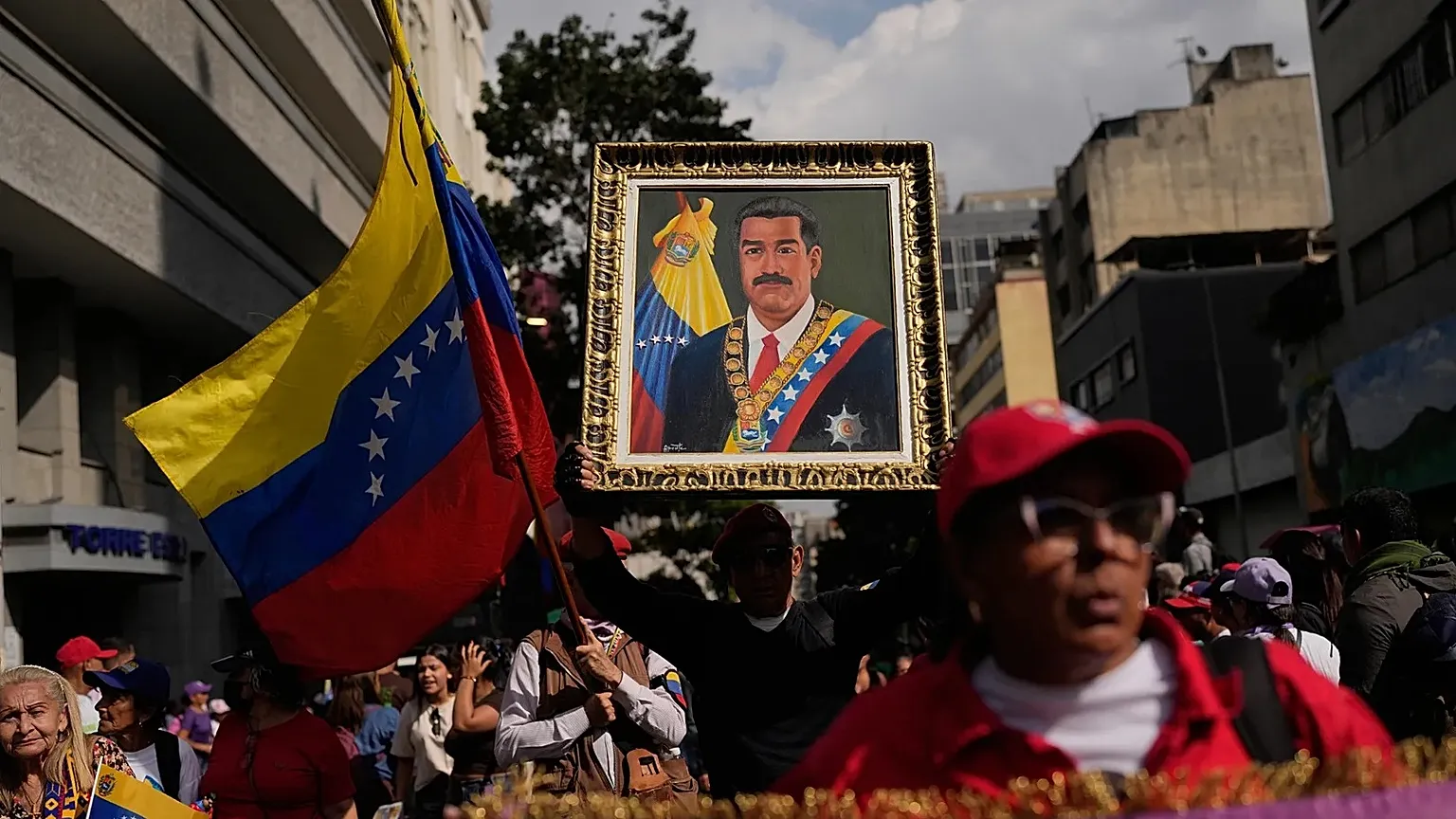
The image of a sitting head of state being extracted by foreign military forces from his own capital is one the international system was meant to have buried with the Cold War. Yet on January 3, 2026, the United States did precisely that in Venezuela. The capture of President Nicolás Maduro under “Operation Absolute Resolve” is not merely a dramatic episode in Latin American politics; it is a stress test for the very idea of sovereignty in the twenty-first century.
While New Delhi has responded with calls for restraint, regional stability, and peaceful dialogue, language consistent with India’s reaction to Russia’s military action in Ukraine in February 2022, the implications of this intervention run far deeper than bilateral India–Venezuela ties. At stake is the credibility of the legal and political architecture on which the Global South has relied to protect itself from the discretionary use of power by stronger states.
BRICS nations voiced sharp concerns over the US military intervention in Venezuela, with Russia labelling it “armed aggression” and dismissing justifications as “groundless,” while China “strongly condemned” the action and urged Washington to “stop toppling the government.” Brazil warned that Maduro’s capture “crosses an unacceptable line” and sets a “dangerous precedent,” and South Africa decried it as a “manifest violation of the UN Charter,” demanding his release. India expressed milder “deep concern” and called for peaceful dialogue to ensure regional stability, highlighting varied intensities within the bloc but a shared emphasis on sovereignty.
The Nature of US Intervention
The 2026 operation represents the largest direct US military intervention in Latin America since the 1989 invasion of Panama. The US military, acting on a presidential directive, forcibly removed a sitting head of state from his capital city and extracted him from Venezuelan territory. Under international law, the action sits on exceptionally thin ice. Article 2(4) of the UN Charter prohibits the use of force against the territorial integrity or political independence of any state, save for self-defence or authorisation by the Security Council. Neither condition was met. The forcible removal of a sitting head of state by a foreign military, absent multilateral mandate, constitutes not merely an infringement of sovereignty but a direct challenge to the prohibition on unilateral regime change—one of the few norms on which broad consensus has historically existed.
Senior officials, including Trump’s adviser Stephen Miller, explicitly claimed US ownership over Venezuelan oil infrastructure and production capacity, framing the nationalisation of Venezuela’s oil industry in 1976 as “theft of American resources.” This rhetoric points to a return, in essence, to the Monroe Doctrine’s original 19th-century logic, where the Western Hemisphere was declared the US sphere of interest and intervention was an expression of regional hegemony. This context was repeated in the US National Security Strategy paper, released on 4 December 2025.
The Venezuela intervention cannot be separated from the two-decade escalation of US economic sanctions that preceded it. Since the 2019 oil embargo, the US has imposed over 200 sanctions on Venezuelan individuals, state entities, and companies, measures undertaken entirely through US domestic legislation. These sanctions have been justified on grounds of combating narco-terrorism and enforcing “international” norms.
Cycle of Interventions
The comparison to the 1989 Panama invasion is instructive. In both cases, the US government justified intervention through individual criminality (drug trafficking, in both Noriega’s and Maduro’s alleged cases), framed action as restoration of democracy and removal of a dictator, and executed the operation without multilateral authorisation.
This cyclical pattern has roots deeper than the Trump administration. US interventions in Guatemala (1954), Dominican Republic (1965), Nicaragua (1980s) proved that the international murmurs of opposing such actions finally fade away. The Venezuela operation is not an anomaly but a reversion to this long-standing pattern after a period when unilateral military intervention faced higher reputational costs.
For India, this history is not academic. It directly shapes the security of its capital, contracts, and long-term energy calculus.
Risks to India
While India’s current trade with Venezuela is small, roughly US$365 million in 2025, down from over US$1 billion in 2023, India’s equity investments in Venezuelan oil projects remain substantial and strategically significant. ONGC Videsh holds a 40% stake in the San Cristóbal field with an investment exposure of approximately US$200 million; Indian companies collectively hold stakes in the Carabobo blocks worth over US$500 million in trapped value due to US sanctions.
A US-controlled or US-aligned government in Venezuela could theoretically prioritise American oil companies over Indian investors, renegotiating terms or nationalising foreign assets under the guise of “restoring” Venezuelan control. Even if Indian investments are honoured under new arrangements, the precedent establishes that US military power can unilaterally alter the legal and political environment governing foreign investment.
India increasingly faces a choice between building together with other Global South nations and BRICS partners, credible deterrence against such intervention and accepting that its interests will be subordinated to hegemonic preferences.
Global Energy Security
The longer-term implications extend to global oil markets and the currency regime that underpins them. Venezuela’s 303 billion barrels of proven reserves represent about 17% of global crude—more than Saudi Arabia. Under US-controlled administration, Venezuelan production could eventually scale from the current 800,000 barrels per day to 2 million or more, flooding global markets with cheap heavy crude. This would benefit US refiners (which are optimised for heavy crude) and would have the effect of reinforcing the petrodollar’s centrality in global energy trade.
For India, the implications are mixed. Lower global oil prices would reduce India’s import bill—a significant benefit, as oil imports represent roughly 12% of India’s total import costs. However, if Venezuelan crude is preferentially directed to US refiners, and Asian refineries (including India’s) are starved of heavy crude supplies, regional prices could spike. India’s refineries, particularly Reliance and Indian Oil Corporation, are designed to process heavy crude and would be disadvantaged if supplies tighten.
The Venezuela precedent arrives at a critical moment for India’s energy security strategy. New Delhi has invested heavily in domestic alternatives: ethanol blending (already achieving 20% by 2025, ahead of schedule), bio-CNG production (targeting 5% blend by 2028-29), and green hydrogen initiatives (aiming for 5 million metric tonnes by 2030). These initiatives are medium-to-long-term bets. In the near term, the next 10-15 years, India remains dependent on crude oil imports, and those imports must come from stable sources.
The petrodollar dimension is equally important. Venezuela, under both Chávez and Maduro, attempted to break the dollar monopoly in oil trade by pricing some sales in euros and yuan. This directly threatened the financial underpinnings of US sanctions power: if oil could be traded outside dollar-denominated banking channels, secondary sanctions on non-US banks become less effective.
India’s Path Forward
What are the options available to India in response to the Venezuela precedent? First, India should articulate that the international rule of law as enshrined in the UN Charter must be respected by all countries, irrespective of their size or prowess.
Second, India should prioritise energy security measures that reduce dependence on vulnerable overseas assets. The acceleration of alternative fuel programs, renewable energy expansion, and strategic petroleum reserves should be understood not as optional green investments but as core national security imperatives. India should also diversify energy sources away from singular reliance on any region or alliance.
Third, India could strengthen BRICS coordination on military and economic responses to interventionism. This is not about aligning with Russia or China against the US, but about establishing mutual guarantees that military intervention will incur reputational and other costs.
Finally, India could recalibrate its non-aligned strategy for an era of contested sovereignty. The Venezuela precedent leaves India with an uncomfortable but unavoidable truth: sovereignty today is no longer guaranteed by law alone, but by the willingness of states to defend the norms that sustain it. Non-alignment, in this context, cannot mean quiet neutrality in the face of power violations; it must mean principled consistency and strategic coordination with others who share an interest in restraining unilateral force. India was among the architects of the post-colonial sovereignty doctrine, giving voice to nations emerging from empire. If that legacy is allowed to erode when it becomes inconvenient, the cost will not be abstract—it will be paid in diminished autonomy, vulnerable investments, and a world where rules bend predictably toward power.