Bangladesh is currently grappling with one of its most turbulent periods in recent history, a crisis that has escalated into a significant concern for India. The deposition of Sheikh Hasina following the “July Revolution” in 2024 not only marked the end of one era but also ignited a fierce battle over power and the fundamental identity of the Bangladeshi state. An interim government, led by Muhammad Yunus and reportedly backed by the military, has seized control. This new regime has outlawed the Awami League, prosecuted many of its senior leaders, and confirmed a death sentence for Hasina related to the 2024 crackdown. From her refuge in India, Hasina denounces these actions as a blatant political vendetta, warning that extremist and anti-Indian forces are gaining ground. Dhaka characterises her as a fugitive who must be returned. As elections approach, the average Bangladeshi is enduring institutional decay, skyrocketing costs, and a politically repressive atmosphere, while a crucial question looms: will the nation evolve into a more inclusive, civilian-led democracy, or regress into a majoritarian, security-driven regime?
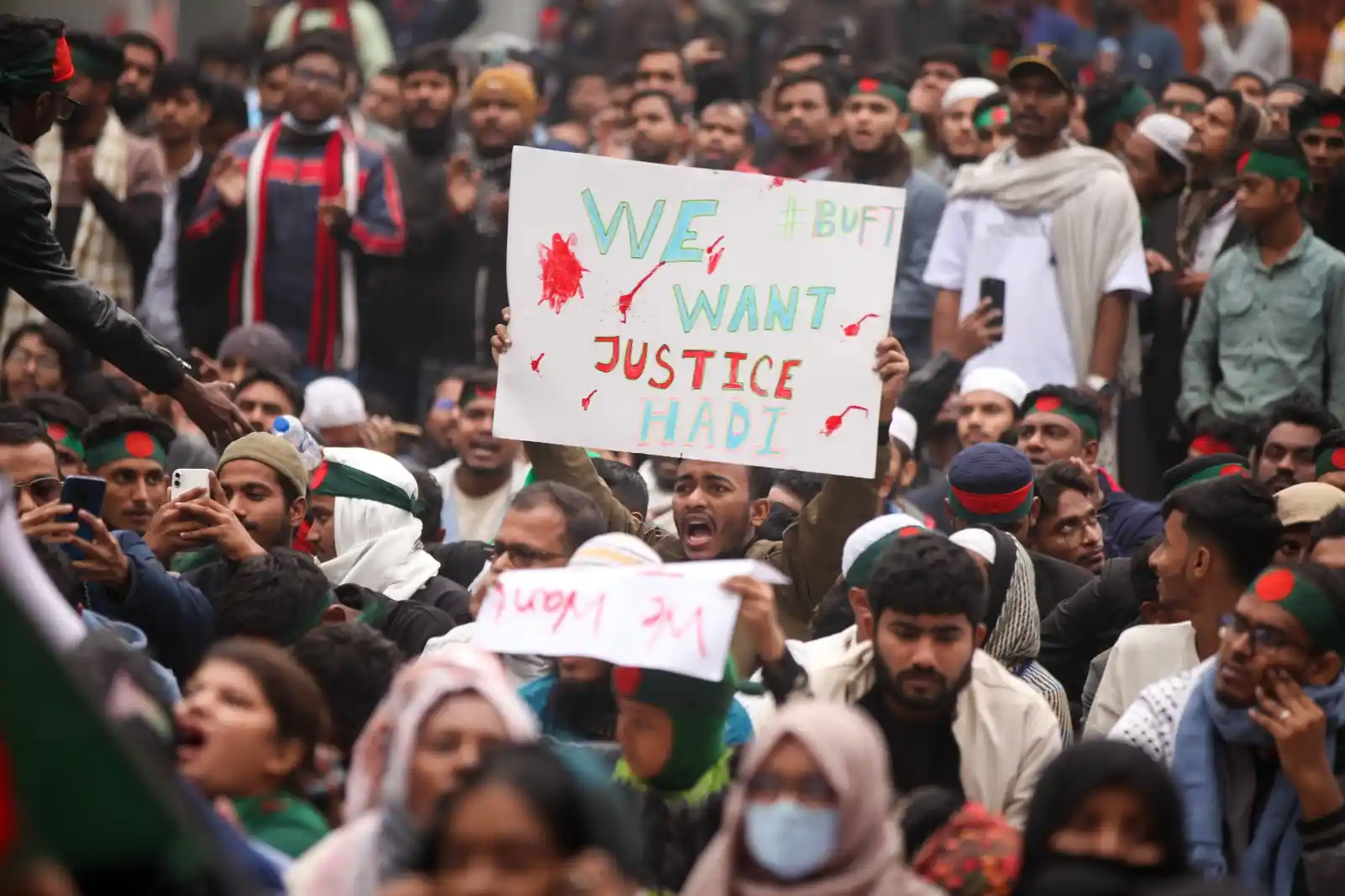
The recent surge of unrest is rooted in a deeply human tragedy: the death of a revered young student leader. Sharif Osman Hadi, a key figure in the 2024 protests, was brutally assaulted in Dhaka, and his subsequent death in the hospital reverberated throughout the nation. Young activists, who once marched by his side, have taken to campuses and streets to mourn and demand accountability. Protests rapidly spread to major cities, escalating into violence in certain areas. Offices, media outlets, and cultural institutions linked to the former regime faced attacks. Many demonstrators directed their ire not just at the interim government but also at India, accusing it—through powerful slogans and placards—of supporting the previous regime and harbouring its leaders. This once-latent resentment toward India has now crystallised into a fierce and overt narrative.
In response, the state deployed substantial force. Border guards, police, paramilitary units, and military personnel flooded key districts. Roadblocks were erected, armoured vehicles patrolled familiar thoroughfares, and young citizens faced searches on their way to lectures or work. Authorities justified these measures as essential to prevent chaos and ensure a violence-free electoral process. However, countless activists, opposition figures, and journalists interpreted this as a clear signal that dissent would be suppressed through intimidation, with the brief window of political freedom that emerged after Hasina’s ousting rapidly slamming shut. Independent media and cultural organisations reported harassment and assaults, with some of their personnel bravely joining small-scale protests to defend what remains of civic life.
Behind the scenes, the political landscape has grown even murkier. The interim government has announced that the Awami League will be barred from participating in the upcoming elections. For millions who have long viewed this party as a vital pillar of national politics, this amounts to a fundamental rewrite of the rules without their consent. This development also indicates that any future parliament is likely to be seen by a substantial segment of the population as illegitimate, regardless of the order of the voting process. Rather than expanding the political landscape after a revolution, Bangladesh is constricting it under the watch of a restructured party system and a formidable security apparatus.
Simultaneously, anti-Indian sentiment has shifted from the periphery to the core of political discourse. Some protest leaders are now demanding the closure of Indian diplomatic missions until those they hold accountable for Hadi’s death are extradited. Demonstrations have converged near Indian consular offices, compelling India to curtail some services and raise concerns about the safety of its diplomats. Bangladesh’s foreign ministry has summoned the Indian envoy to express its grievances over alleged activities on Indian soil. In response, India has summoned Bangladesh’s representative in New Delhi to address worries about the security landscape and what it perceives as orchestrated hostility. This conflict has evolved beyond mere policy disputes into a deeply personal and emotionally charged confrontation on both sides of the border.
At the border, lives are being profoundly affected. Security forces on both sides have intensified their patrols, especially in districts impacted by protests and crackdowns. Reports are emerging of families seeking to cross quietly into India to escape violence, arrests, or crushing economic hardship. Although verifying exact figures is challenging, the pervasive anxiety is undeniable. Local officials and political leaders in Indian border states are increasingly sounding alarms about the potential for new waves of migration and the strain this could place on already fragile social dynamics. For communities that remember previous influxes, the spectre of upheaval is both real and alarming.
India’s handling of Hasina’s presence and her legal situation is set to attract intense scrutiny from leaders across South Asia. Should Delhi swiftly distance itself from her, it may signal that Indian support is fundamentally transactional. On the other hand, if India chooses to protect her in the face of a court ruling, critics could justifiably accuse it of meddling in another nation’s judicial affairs. Each of these scenarios poses significant risks for a country striving to establish itself as a stable and principled power in its region.
Within India, the unfolding events in Bangladesh are already resonating across its border states, which are particularly sensitive to migration, identity, and communal dynamics. Political parties and the media in these areas are on high alert for any indication that the central government is mishandling the situation next door, ready to leverage it for political gain domestically. This pressure complicates New Delhi’s ability to engage in discreet and flexible diplomacy yet it is precisely this quiet and adaptable approach that is needed now. India must draw clear lines regarding the safety of its citizens and the integrity of its borders, all while resisting the temptation to be cast as either a convenient scapegoat or a puppet master in Bangladesh’s internal political theatre.
The crisis in Bangladesh transcends the fate of an exiled leader or the exclusion of a single party from an election; it fundamentally concerns the future of a neighbouring nation with 170 million people and the broader stability of India’s eastern flank. The choices made in Dhaka, along with India’s responses, will critically determine whether the Bay of Bengal transforms into an arena of cooperation and connection or devolves into a battleground of distrust and competing influences.